
Commercial Lawn Mowing is more than keeping grass short. For New Zealand businesses, body corporates, schools, retail sites, rental property managers, and public-facing facilities, it affects safety, first impressions, pest control, access, and long-term turf health. From a service-planning perspective, the best results usually come from a clear scope, a reliable schedule, and a contractor who understands local weather, site risk, and presentation standards.
Table of Contents
- What Is Commercial Lawn Mowing?
- What Commercial Lawn Mowing Includes in New Zealand
- Why Commercial Lawn Mowing Needs a Different Plan
- Commercial Lawn Mowing Schedule for New Zealand Conditions
- Comparison Table: Service Models for Commercial Sites
- Safety, Access and Admin for Commercial Lawn Mowing
- Biosecurity and Environmental Care in Commercial Lawn Mowing
- How to Choose a Commercial Lawn Mowing Contractor
- Commercial Lawn Mowing Onboarding Checklist
- Common Mistakes to Avoid
- People Also Ask
- Expert Q&A
- Conclusion
What Is Commercial Lawn Mowing?
Commercial Lawn Mowing is the planned cutting, edging, clipping control and presentation care of lawns across business, body corporate, school, retail and public-facing sites. In New Zealand, it should account for grass growth, weather, access, visitor safety, biosecurity and clear service records.
What Commercial Lawn Mowing Includes in New Zealand
Commercial Lawn Mowing usually includes mowing, edge trimming, line trimming around posts and fences, clearing paths, blowing grass from hard surfaces, and checking visible hazards before work starts. However, the exact scope should be written down because every commercial site has different risks and expectations.
For example, an office frontage may need a clean finish before staff and visitors arrive. A childcare centre may need extra attention around gates, play areas and loose objects. Meanwhile, an industrial property may need wider grassed areas controlled so visibility and access stay clear.
A strong commercial mowing service often covers:
- Regular mowing at agreed intervals
- Lawn edging along paths, kerbs and driveways
- Line trimming around fences, signs, bollards and trees
- Blowing clippings from entrances, car parks and footpaths
- Green waste handling, either mulched on site or removed
- Basic site checks before mowing
- Reporting of hazards, drainage problems, weeds or turf damage
- Seasonal adjustments for wet weather, dry periods and growth changes
In New Zealand, outdoor work also needs practical weather planning. According to NIWA weather and climate information, NIWA provides site-specific forecasts, daily climate maps, seasonal outlooks and climate summaries that can help businesses understand rainfall, soil moisture and regional conditions. This matters because mowing wet, saturated ground can leave ruts, spread clippings badly and create a poor finish.
Why Commercial Lawn Mowing Needs a Different Plan
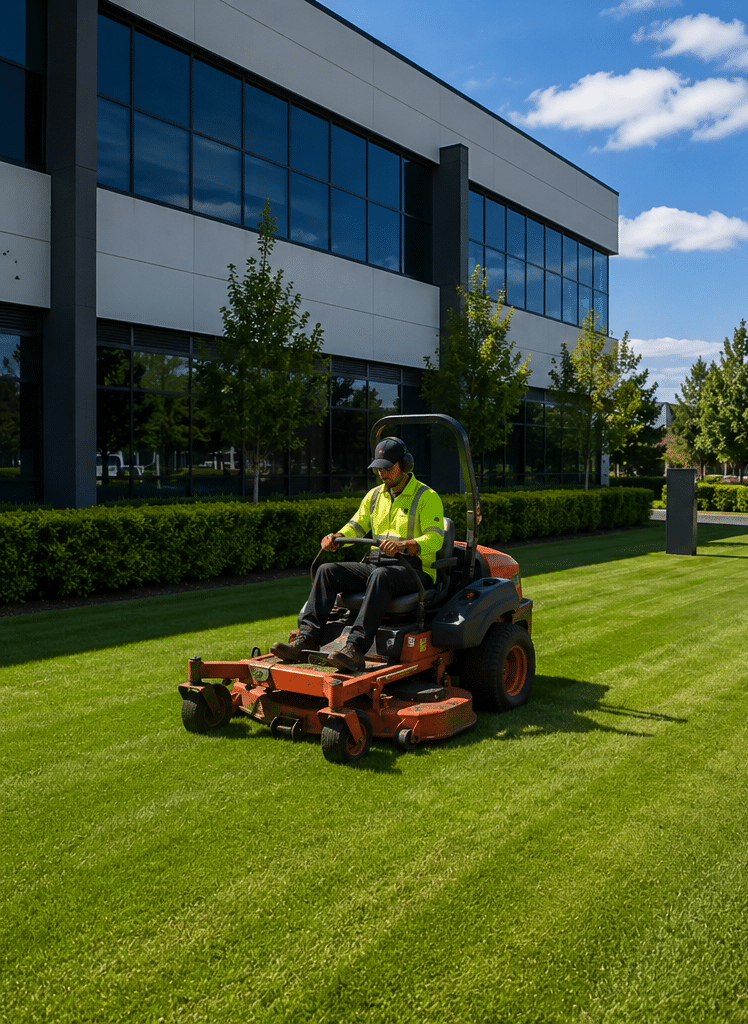
Residential lawn mowing is usually judged by appearance and convenience. Commercial Lawn Mowing has a wider job. It supports brand image, site safety, tenant satisfaction, customer access and property management routines.
A commercial property often has more people moving through it. Therefore, the contractor needs to think about cars, pedestrians, delivery vehicles, staff, visitors, children, residents or members of the public. In practice, this means mowing should be scheduled around peak traffic times where possible.
Commercial sites also have more fixed assets. These can include signs, irrigation fittings, stormwater drains, lighting, security cameras, outdoor furniture, low fencing, service boxes and garden edging. So, the contractor needs to work carefully around them and report damage risks early.
There is also a stronger need for consistency. A business frontage that looks tidy one week and neglected the next can affect how customers feel before they enter the premises. For body corporate properties, inconsistent mowing can lead to complaints from residents. For schools or aged-care sites, unmanaged grass can make supervision, access and grounds presentation harder.
The “why” is simple: commercial mowing protects the look and usability of the site. It also reduces avoidable admin for managers who do not want to chase contractors, handle repeated complaints or explain missed visits.
Commercial Lawn Mowing Schedule for New Zealand Conditions
A good mowing schedule should match the season, the grass type, the site use and the level of finish required. In many parts of New Zealand, lawns grow faster during warmer, wetter periods and slower during colder months. However, conditions vary between Auckland, Hamilton, Wellington, Christchurch, Dunedin and regional areas.
For example, Auckland’s mild and humid conditions can support frequent growth across much of the year. Canterbury sites may need more careful planning during dry or windy periods. In Wellington, exposed sites can dry quickly, while shaded lawns may stay damp for longer. Therefore, a fixed schedule should still allow sensible adjustments.
As a practical guide, high-presentation commercial sites may need mowing every 1 to 2 weeks during peak growing periods. Lower-use sites may need less frequent visits. This is an estimate, not a rule. The right interval depends on rainfall, irrigation, grass species, soil, shade, budget and the standard expected by tenants or customers.
Commercial Lawn Mowing should also consider the “one-third rule”. This means avoiding cutting more than about one-third of the grass blade in one mow. The reason is that severe cutting can stress the lawn, weaken roots and leave the site looking scalped. Although every site is different, regular moderate cutting usually gives a cleaner and healthier finish than irregular heavy mowing.
Another practical point is timing. For public-facing properties, mowing before opening hours can reduce disruption. However, early mowing may create noise concerns in mixed-use or residential-adjacent areas. Therefore, property managers should check local council expectations and any lease, body corporate or site rules before confirming after-hours maintenance.
In Auckland, berms are a common admin issue. Auckland Transport states that the property owner is responsible for mowing the berm outside their property, although there are exceptions where maintaining the berm creates a safety risk, such as a steep gradient. For businesses outside Auckland, check the relevant local council because berm and verge expectations can vary.
Comparison Table: Commercial Lawn Mowing Service Models
| Service model | Best for | Main benefits | Watch-outs |
| Ad-hoc mowing | Small sites, vacant lots, occasional clean-ups | Flexible and simple to book | Can become expensive or inconsistent if the lawn grows quickly |
| Scheduled Commercial Lawn Mowing | Offices, retail sites, schools, rentals, body corporates | Predictable finish, easier budgeting, fewer missed visits | Needs a clear scope and seasonal review |
| High-presentation mowing | Hotels, medical centres, display homes, premium retail | Strong first impression and cleaner edges | Usually needs more frequent visits |
| Grounds maintenance bundle | Larger sites with lawns, gardens, hedges and weed control | One provider can manage more of the outdoor area | Requires good reporting and clear task separation |
| Seasonal contract | Sites with strong spring and summer growth | Matches workload to the growing season | Winter expectations should still be documented |
The best option is not always the most frequent one. For example, a high-profile showroom may need a premium finish every week in spring. However, a low-traffic warehouse frontage may only need reliable scheduled mowing and tidy edges. The right choice depends on risk, visibility, budget and how quickly the site looks untidy.
Safety, Access and Admin for Commercial Lawn Mowing
Commercial Lawn Mowing involves moving blades, thrown objects, noise, vehicles, slopes, heat, wet ground and people moving through the same space. So, safety planning should be practical and site-specific.
According to WorkSafe NZ risk management guidance, businesses need to identify, assess and manage health and safety risks based on the work they do. For mowing, that means checking the site, choosing safe methods, using suitable equipment and managing risks to workers and others nearby.
Business.govt.nz also advises businesses to assess risks with staff and think about who else may be affected, including visitors, customers, contractors and neighbouring businesses. That is especially relevant for Commercial Lawn Mowing because the work often happens around open car parks, entrances, footpaths and shared areas.
A useful commercial mowing risk review may include:
- Are there stones, wire, glass or hidden objects in the grass?
- Are pedestrians likely to pass through while mowing happens?
- Are there steep slopes, wet patches or unstable ground?
- Are vehicles entering and exiting nearby?
- Are there children, residents, patients or customers on site?
- Are there irrigation heads, cables, low lights or signs?
- Is hearing protection, eye protection or high-vis clothing needed?
- Should cones or temporary exclusion zones be used?
- Is there a safe place to unload and park equipment?
- Who should be contacted if weather or access prevents mowing?
A PCBU means a “Person Conducting a Business or Undertaking”, and WorkSafe explains that most New Zealand businesses, including sole traders and self-employed operators, are PCBUs. This article is not legal advice, but for admin purposes it is sensible for property managers and contractors to clarify responsibilities, site access, reporting and risk controls before work starts.
Invoices and records matter too. Inland Revenue says new GST rules from 1 April 2023 replaced the old tax invoice requirement with taxable supply information, while keeping GST calculation rules the same. For Commercial Lawn Mowing contracts, that means the admin should clearly show who supplied the service, what was supplied, dates, amounts, GST details where relevant, and any agreed service notes. Ask an accountant or tax adviser for advice on your own record-keeping requirements.
Biosecurity and Environmental Care in Commercial Lawn Mowing
New Zealand has strong biosecurity expectations because weeds, pests and diseases can spread through soil, seeds, clippings and dirty equipment. This is not only a farming issue. Commercial mowing contractors can move between many sites in one day, so basic cleaning habits matter.
According to MPI biosecurity guidance, harmful pests and diseases can damage New Zealand, and biosecurity focuses on stopping them at the border or removing those already present. For mowing, the practical lesson is to avoid moving weed seed, soil and plant material from one property to another.
Good environmental practice may include:
- Cleaning decks, wheels and line trimmers when moving between high-risk sites
- Avoiding mowing through known weed seed heads where practical
- Keeping clippings away from stormwater drains
- Mulching only when it suits the turf and site conditions
- Removing heavy clumps after wet mowing
- Reporting invasive weeds or suspicious plant disease
- Avoiding unnecessary damage to tree roots and garden beds
- Using suitable mowing heights during dry periods
- Planning work to reduce repeat travel where possible
This matters for commercial properties because poor mowing can create hidden costs. For instance, clippings blown into drains can create a maintenance issue. Scalped lawns can increase weed pressure. Dirty machinery can spread seeds. Over time, a cheap cut can become an expensive repair.
Balanced decision-making is important. Removing all green waste can look tidy, but it may increase cost and disposal needs. Mulching can return organic material to the lawn, but it only works well when the grass is not too long or wet. Therefore, the right approach depends on the site and season.
How to Choose a Commercial Lawn Mowing Contractor
Choosing a Commercial Lawn Mowing contractor should not be based on price alone. Price matters, but the cheaper quote can cost more if the provider misses visits, damages assets, leaves clippings in entrances or cannot work safely around people.
A better way to compare contractors is to ask how they manage the work. In my experience with service briefs, the most reliable providers tend to ask detailed questions before quoting. They want to know the site size, access points, mowing frequency, preferred hours, traffic flow, waste expectations and any sensitive areas.
Before approving a contractor, ask for:
- A written scope of work
- Visit frequency and seasonal adjustment options
- Public liability insurance details
- Health and safety process or site risk method
- Equipment suitable for the property size
- Contact person for missed visits or urgent issues
- Green waste approach
- Reporting process for hazards and property damage
- Photos or notes after visits, if needed
- Clear pricing and GST details where applicable
You should also clarify what is not included. For example, lawn mowing may not include spraying, fertilising, lawn repair, hedge trimming, garden waste removal, irrigation repairs or tree work unless the contract says so.
A strong quote should separate mowing from other grounds maintenance. That way, you know what you are paying for and can compare suppliers fairly.
Commercial Lawn Mowing Onboarding Checklist
Use this numbered checklist before starting a new Commercial Lawn Mowing agreement.
- Walk the site with the contractor. Show entrances, high-traffic areas, slopes, drains, gates, parking areas and sensitive zones.
- Confirm the mowing area. Mark what is included, such as berms, internal lawns, rear access strips and shared outdoor spaces.
- Set the finish standard. Decide whether the site needs a basic tidy cut, a high-presentation finish or a premium edge detail.
- Agree on visit frequency. Set a normal schedule, then allow seasonal changes for spring growth, wet weeks and dry periods.
- Choose suitable work times. Avoid peak customer, school, tenant or delivery periods where possible.
- Identify hazards. Note steep ground, wet zones, loose stones, low fixtures, hidden cables, irrigation heads and public access points.
- Clarify clipping management. Decide whether clippings are mulched, collected, blown off hard surfaces or removed from site.
- Set communication rules. Agree who receives updates, photos, missed-visit notices and hazard reports.
- Check admin details. Confirm purchase order needs, GST records, insurance information and billing frequency.
- Review after the first month. Adjust the schedule, finish standard or access plan once you see how the site responds.
This checklist keeps the relationship clear. Also, it prevents the common problem where the property manager expects full grounds care, while the contractor has only priced basic mowing.
Common Mistakes to Avoid
The first mistake is choosing the lowest quote without checking the scope. Two mowing quotes can look similar, but one may include edging, clipping removal and site reporting while the other only includes a fast cut.
The second mistake is using one schedule all year. New Zealand lawns do not grow at the same pace every month. Therefore, a commercial lawn may need more visits in active growth periods and fewer visits during slower months.
The third mistake is ignoring access. If gates are locked, cars block lawns, or staff do not know the mowing day, the contractor may need to skip sections. As a result, the property can look patchy even when the provider attended.
The fourth mistake is mowing too low. Some managers ask for a very short cut because they think it will last longer. However, cutting too low can stress turf, expose soil, encourage weeds and leave the lawn looking brown.
The fifth mistake is not reporting small issues. A broken irrigation head, a sunken drain, a loose sign or a recurring wet patch can become more expensive if ignored. A good Commercial Lawn Mowing provider should help notice these issues early, even if fixing them is outside the mowing scope.
People Also Ask
1. How often should Commercial Lawn Mowing be done in New Zealand?
Most commercial sites need mowing more often during active growth periods and less often in colder or drier months. As a practical estimate, high-presentation sites may need service every 1 to 2 weeks in peak growth, but the right schedule depends on local weather, grass type, irrigation, shade and site use.
2. What is included in a Commercial Lawn Mowing service?
A typical service includes mowing, edging, line trimming, clearing paths and basic clipping control. However, weed control, fertilising, lawn repair, hedge trimming and green waste removal should be confirmed separately because they are not always included.
3. Is Commercial Lawn Mowing different from residential mowing?
Yes. Commercial Lawn Mowing usually involves more people, more assets, stricter timing, higher presentation standards and clearer reporting. It also needs stronger planning around access, public safety, vehicles and site-specific risks.
4. Do businesses need to mow the berm outside their property?
It depends on the council area. In Auckland, Auckland Transport says the property owner is responsible for mowing the berm outside their property, with limited exceptions for safety risks. Other New Zealand councils may have different rules, so check the local council before finalising the scope.
5. Should clippings be removed from commercial lawns?
Not always. Mulching can be suitable when mowing is frequent and the grass is dry enough. However, clippings should usually be cleared from entrances, paths, car parks and high-presentation areas because they can look messy and create slip or drainage issues.
Expert Q&A: Commercial Lawn Mowing in New Zealand
1. What should a commercial mowing contract include?
A commercial mowing contract should include the site address, mapped mowing areas, visit frequency, service standard, clipping approach, work times, access instructions, reporting process, insurance expectations and pricing. It should also say what is excluded, such as spraying, fertilising, lawn repair or garden maintenance.
This protects both sides. The property manager gets predictable service, and the contractor can price the work properly.
2. How can property managers reduce disruption during mowing?
Start by choosing low-traffic work times. Then, tell tenants, staff or site users when mowing usually happens. For busy sites, ask the contractor to work in zones so entrances, car parks and shared paths stay usable.
Good communication is often enough to prevent complaints. However, high-risk sites may need cones, temporary exclusion areas or a staff contact on site.
3. What makes a commercial lawn look professionally maintained?
A professionally maintained lawn has even cutting, clean edges, no obvious clumps, tidy paths, controlled growth around posts and fences, and no scalped patches. The finish should look intentional, not rushed.
Consistency matters more than one perfect cut. Therefore, regular Commercial Lawn Mowing with seasonal adjustments usually gives better results than occasional heavy mowing.
4. What should contractors report after mowing?
Contractors should report blocked access, missed areas, damaged fixtures, unsafe ground, broken irrigation, heavy weeds, pest signs, drainage problems and any incident or near miss. Photos are useful for body corporates, commercial landlords and remote property managers.
This reporting is not about creating extra paperwork. Instead, it helps managers act early before a small issue becomes a complaint or repair bill.
5. How do I compare Commercial Lawn Mowing quotes fairly?
Compare the scope, not just the price. Check whether each quote includes edging, line trimming, blowing hard surfaces, green waste handling, travel, GST, reporting and seasonal flexibility.
Also, compare reliability. A slightly higher quote from a well-organised contractor may deliver better value if it reduces missed visits, complaints and rework.
Conclusion
Commercial Lawn Mowing in New Zealand works best when it is planned, consistent and suited to the site. The right service should keep lawns tidy, protect access, support safety, respect local conditions and reduce admin for property managers.
Therefore, before choosing a provider, define the mowing area, confirm the finish standard, agree on timing, check safety processes and review the service after the first few visits. A well-managed mowing plan can make a business property look cared for every week, not only after a one-off tidy-up.
For reliable outdoor care that supports cleaner, safer and better-presented commercial properties, explore commercial lawn care support in New Zealand.